
-
No EMD Required
Registered MSEs can bid on government tenders without an Earnest Money Deposit -
Government Procurement
Access to reserved government procurement and tender opportunities -
Single Point Registration
Registration under NSIC’s Single Point Registration Scheme (SPRS)
What is NSIC Registration?
NSIC Registration refers to registration under the schemes and programmed offered by the National Small Industries Corporation (NSIC), a Government of India enterprise that supports Micro and Small Enterprises (MSEs).
One of the key registrations offered through NSIC is under the Single Point Registration Scheme (SPRS), which helps eligible Micro and Small Enterprises participate in government procurement and tender opportunities, subject to the applicable rules and conditions.
Who Needs NSIC Registration?
-
Micro Enterprises
-
Small Enterprises
-
Manufacturers
-
Service providers, where eligible under the applicable scheme
-
Businesses supplying goods or services to government departments
-
Businesses interested in participating in government tenders
-
Eligible MSEs seeking benefits under NSIC schemes
Types of NSIC Registration
-
1. NSIC Single Point Registration Scheme (SPRS) The Single Point Registration Scheme is intended to help eligible MSEs participate in government procurement opportunities. Registered units may receive applicable benefits under the Government Purchase Programmed, subject to eligibility and tender conditions.
-
2. Provisional NSIC Registration Eligible new MSEs that meet the applicable conditions may be considered for provisional registration under the relevant scheme. The validity and requirements depend on the applicable NSIC guidelines.
-
3. Regular NSIC Registration Eligible established MSEs may apply for regular registration after meeting the required eligibility criteria and completing the applicable assessment process.
Benefits of NSIC Registration
-
1. Access to Government Tender Opportunities NSIC Registration can help eligible MSEs participate in government procurement and tender opportunities.
-
2. Tender Document Benefits Registered eligible MSEs may receive benefits relating to tender documents or fees, subject to the applicable Government Purchase Policy and tender conditions.
-
3. Earnest Money Deposit (EMD) Benefits Eligible NSIC-registered MSEs may receive exemptions or benefits relating to Earnest Money Deposit requirements, subject to the applicable tender and procurement rules.
-
4. Increased Business Opportunities Registration can help eligible businesses explore procurement opportunities with government departments, ministries and public sector organizations.
-
5. Business Credibility NSIC Registration can enhance the credibility of an eligible MSE when participating in applicable government procurement processes.
-
6. Support for Micro and Small Enterprises NSIC schemes are designed to provide various forms of support to eligible MSEs, depending on the scheme and applicable conditions.
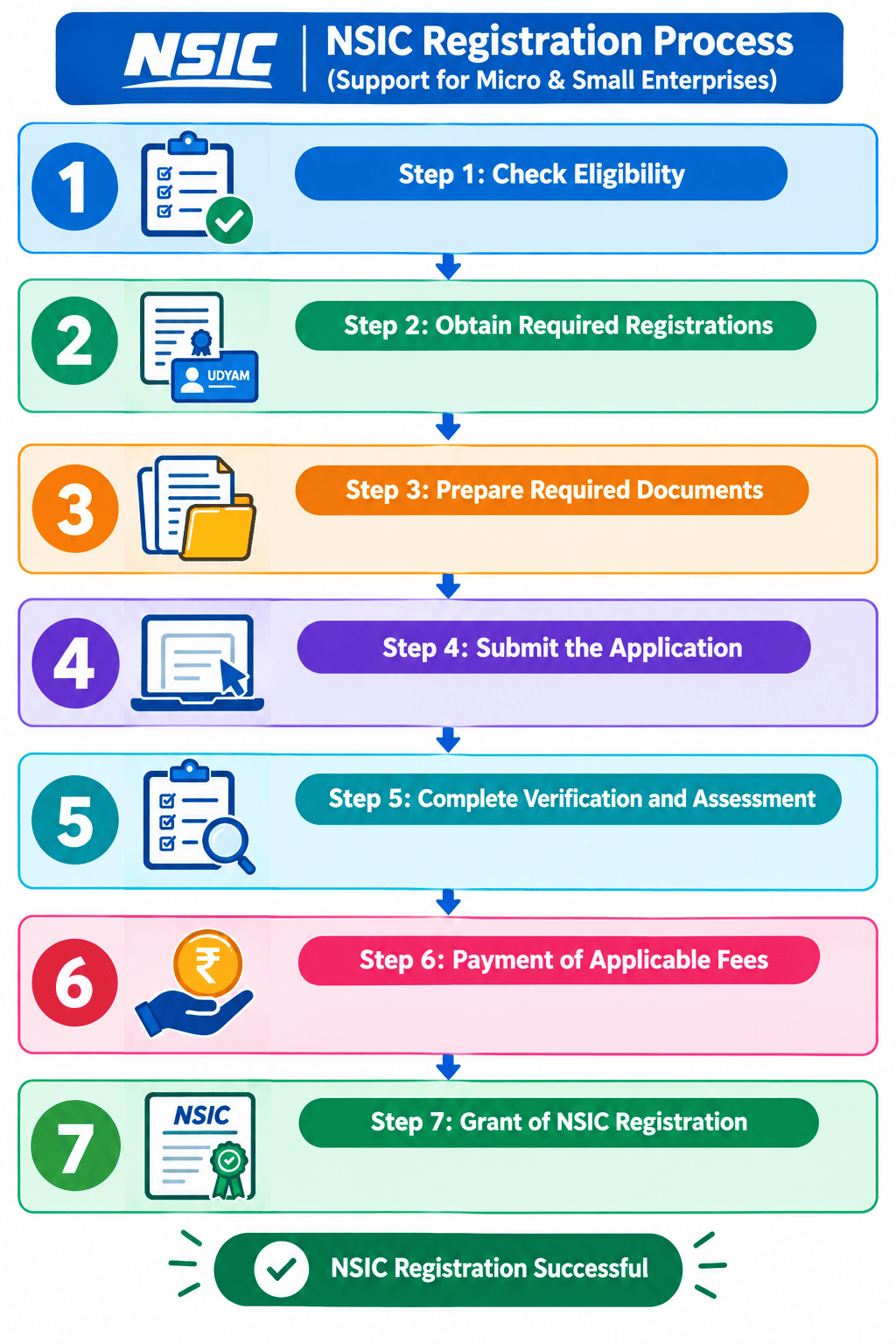
NSIC Registration Process
-
Step 1: Check Eligibility Confirm whether the business qualifies as an eligible Micro or Small Enterprise under the applicable NSIC scheme.
-
Step 2: Obtain Required Registrations Ensure that required business registrations and MSE/Udyam Registration details are available, where applicable.
-
Step 3: Prepare Required Documents Collect the required business, financial, technical and product or service-related documents.
-
Step 4: Submit the Application Submit the NSIC Registration application through the applicable portal or prescribed process.
-
Step 5: Complete Verification and Assessment The business and submitted documents may be subject to verification, inspection or technical assessment, as applicable.
-
Step 6: Payment of Applicable Fees Pay the applicable registration, inspection or assessment charges.
-
Step 7: Grant of NSIC Registration After successful completion of the applicable process, the registration certificate may be issued to the eligible enterprise.
Documents Required for NSIC Registration
-
PAN Card of the business/entity
-
Aadhaar Card or identity proof of the authorized person
-
Udyam Registration Certificate
-
GST Registration Certificate, if applicable
-
Business address proof
-
Bank account details and cancelled cheque
-
Certificate of Incorporation, Partnership Deed, or other constitution documents, as applicable
-
Memorandum of Association (MOA) and Articles of Association (AOA), for companies
-
Details of business activities, products, or services
-
Financial statements or audited financial documents, where applicable
-
Details of machinery and equipment, for manufacturing enterprises, where applicable
-
Previous work orders, purchase orders, or experience certificates, if applicable
-
Income Tax Returns, where required
-
Any additional documents requested by the concerned NSIC authority
FAQS
NSIC Registration is a registration facility for eligible Micro and Small Enterprises (MSEs) that helps them access applicable government procurement benefits and business opportunities.
Eligible Micro and Small Enterprises engaged in manufacturing or services may apply, subject to the requirements of the applicable NSIC scheme.
No. NSIC Registration is not mandatory for every business. It is mainly useful for eligible MSEs looking to participate in government procurement opportunities.
Benefits may include tender-related concessions, exemption from tender fees and EMD in qualifying cases, and access to applicable government procurement opportunities.
Udyam Registration is generally important for establishing MSME status. However, specific requirements may vary depending on the applicable NSIC scheme.
Common documents include PAN, identity proof, Udyam Registration Certificate, GST Certificate where applicable, business address proof, bank details, and relevant business or financial documents.
The processing time can vary depending on document completeness, verification requirements, and the applicable NSIC process.
Yes, eligible service enterprises may apply, subject to the applicable eligibility criteria and scheme requirements.
Eligible MSEs may receive EMD exemption in qualifying government tenders, subject to the applicable procurement rules and tender conditions.
No. NSIC Registration does not guarantee the award of any government tender. It may provide eligible businesses with applicable procurement benefits.
A startup may apply if it meets the eligibility requirements of the applicable NSIC scheme and qualifies as an eligible MSE.
BDS Legal Services can assist with eligibility guidance, document preparation, application support, document review, and coordination throughout the registration process.
Get Personalized Quote for NSIC Registration
Fill in your details below and our experts will get in touch with you to guide you through NSIC registration & compliance.