-
60 Years
Duration of copyright protection -
Automatic Protection
Rights exist from the moment of creation -
Legal Recourse
Statutory damages & attorney fees on infringement
What is Copyright Registration?
The moment you write a song, paint something, code a piece of software, or shoot a video, you already own the copyright to it — this protection kicks in automatically the second your work is created. So why register it at all?
Because a registered copyright gives you what automatic protection can’t: official proof. It’s a government-issued record that says, on a specific date, this exact work belonged to you. If someone ever copies your work or tries to claim it as their own, that certificate becomes your strongest evidence in court — and it’s often required before you can even file an infringement case or claim damages.
In India, copyright registration is handled under the Copyright Act, 1957 by the Copyright Office, and it covers everything from books and blog posts to songs, films, software, logos, and photographs. BDS Legal helps authors, businesses, YouTubers, and designers across India get their work registered properly, with plans starting at just ₹599.
Who Needs Copyright Registration?
You don’t have to be a famous author or a big production house to need this. Copyright registration makes sense for:
-
Writers & Bloggers Books, articles, poems, scripts, course content, and website copy.
-
Musicians & Composers Songs, background scores, and original compositions.
-
Designers & Artists Logos, illustrations, paintings, and photographs — especially logos used commercially on products or packaging.
-
Software Developers Apps, source code, and proprietary tools.
-
Filmmakers & YouTubers Videos, short films, and original video content.
-
Businesses & Startups Brand content, training material, and any original creative work tied to your company.
Types of Works You Can Copyright
-
Literary Works Books, articles, blogs, poems, and computer programs.
-
Artistic Works Paintings, sculptures, photographs, and logos.
-
Musical Works Songs and original compositions.
-
Dramatic Works Plays, scripts, and choreography.
-
Cinematograph Films Movies, short films, and video content.
-
Sound Recordings Podcasts, audio tracks, and recorded music.
Benefits of Copyright Registration
-
Solid Proof of Ownership A registered copyright is a public record with a clear date, which is hard to argue against in a dispute.
-
The Right to Sue and Claim Damages In most cases, you need a registered copyright before you can take legal action or claim statutory damages and legal costs from an infringer.
-
A Real Deterrent People are far less likely to steal work that’s visibly, officially registered.
-
Easier Licensing and Deals Publishers, platforms, and buyers move faster when your ownership is already on public record.
-
Peace of Mind You stop worrying about “what if someone copies this” once your work is on file.
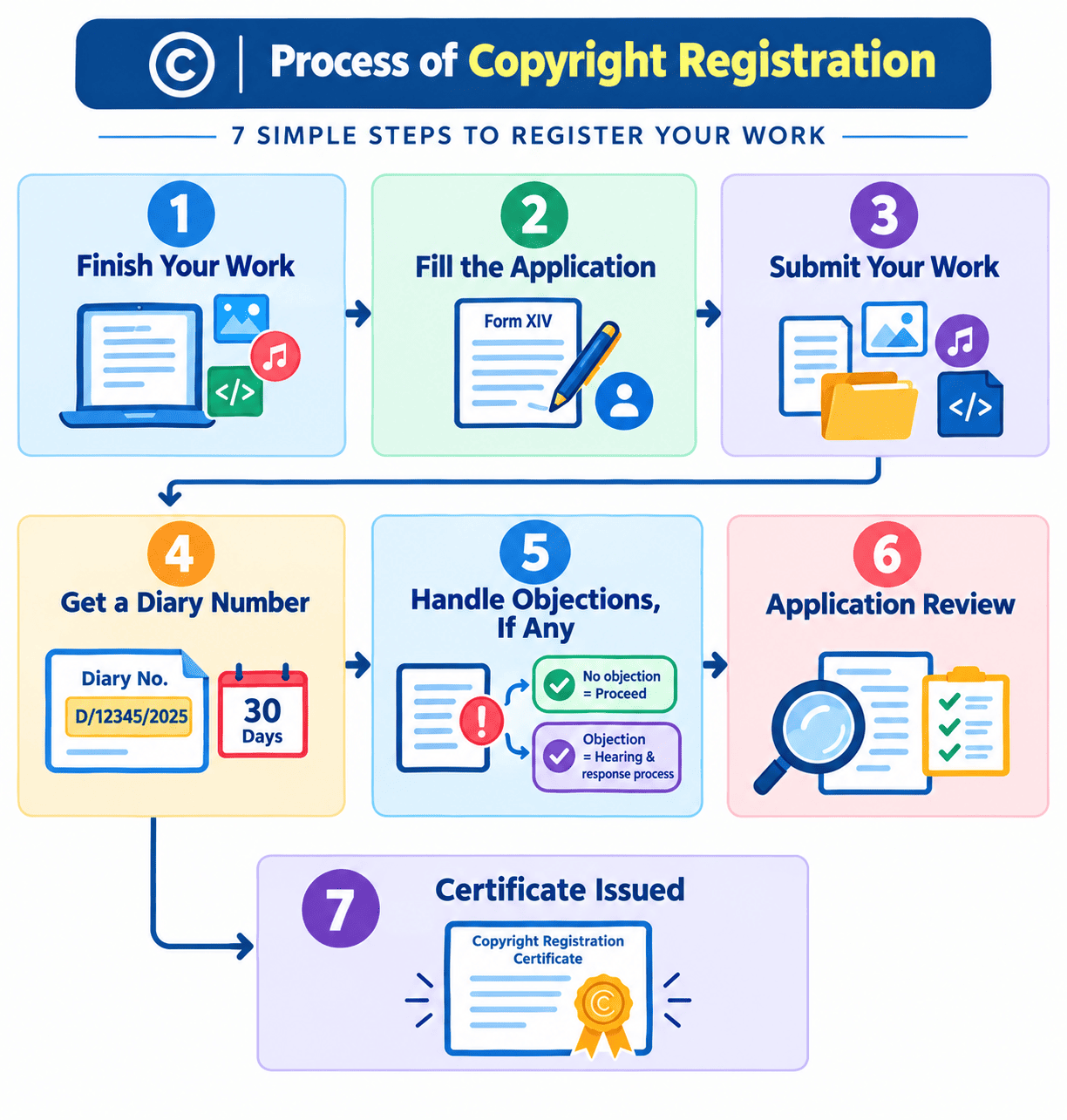
Process of Copyright Registration
-
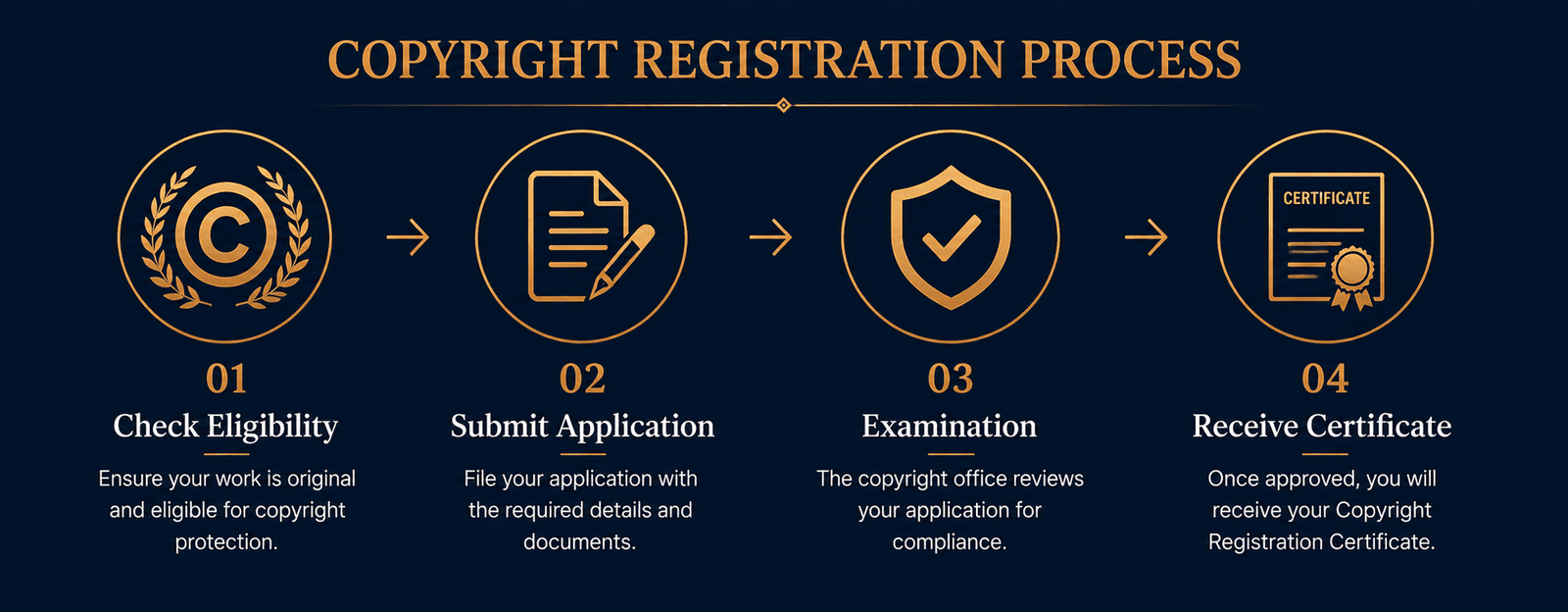
Step 1 : Finish Your Work It has to exist in a fixed, tangible form — written, recorded, coded, or saved, not just an idea in your head.
-
Step 2 : Fill the Application This is done through Form XIV, with details about the work, the creator, and the type of copyright being claimed.
-
Step 3 : Submit Your Work A copy of the actual work goes in with the application — a manuscript, audio file, image, or source code, depending on the category.
-
Step 4 : Get a Diary Number The Copyright Office assigns this to track your file, and a 30-day public objection window opens.
-
Step 5 : Handle Objections, If Any If nobody objects, your file moves ahead. If someone does, it goes through a hearing and response process.
-
Step 6 : Application Review An examiner checks your file for accuracy and completeness.
-
Step 7 : Certificate Issued Once cleared, you receive your official copyright registration certificate.
How Long Does Copyright Protection Last?
In India, copyright protection generally lasts 60 years for most works — this is counted from the year after the creator’s death, though the exact starting point can vary slightly by category (for example, films and sound recordings count from the year of publication). Unlike a trademark or ISO certificate, there’s no renewal needed once granted — it simply runs its course.
The Copyright Office, functioning under India’s copyright law framework, is the authority that handles registration nationally. BDS Legal’s India offices coordinate filings across different states, ensuring smooth processing and reliable support wherever you are.
Documents Required
-
Copy of the Original Work PDF for text, JPG for artwork, MP3 for audio, source code for software.
-
Identity Proof of the Creator Aadhaar or PAN card.
-
Address Proof
-
A No-Objection Certificate from the publisher, if the work is already published and you're not the publisher
-
A trademark search certificate, if you're registering an artistic work (like a logo) that's used commercially on goods or services
Plans & Pricing
Copyright registration pricing depends on how much support you need — from a basic search to full filing and follow-up. Here’s how BDS Legal structures it.
Basic
- Scope-of-Work Assessment
- Correct Classification
- Preliminary Search
- Professional Search Services
Standard
- Everything in Basic plus
- Full Application Drafting
- Classification Under the Right Category
- Filing With the Copyright Office (Online or Offline)
Advanced
- Everything in Advanced plus
- Handling the Examination Stage
- Responding to Examination Report & Hearings
- Submitting Supporting Evidence
- Follow-Through to Final Registration
We help clients register copyright in Pan India under the same transparent pricing, so wherever you're based, you get a clear breakup of the professional fee and the government fee - no guesswork.
FAQ for Copyright Registration
Get Personalized Quote for Copyright Registration
Fill in your details below and our experts will get in touch with you to guide you through Copyright Registration.