-
₹1,770/-*
Starting professional fee (excl. Govt fees & taxes) -
GSTIN & Certificate
Registration certificate issued on approval -
7–15 Working Days
Typical GST registration processing time
What is GST Registration?
GST (Goods and Services Tax) is an indirect tax applicable to the supply of goods and services in India. GST Registration provides a business with a unique GST Identification Number (GSTIN) and enables it to collect GST from customers and claim eligible input tax credit.
Whether you are starting a new business, selling products online, providing professional services, or expanding your business across India, GST registration may be required depending on your business activities and applicable legal requirements.
GST registration may be required for:
-
Businesses Above the Turnover Threshold Businesses whose turnover exceeds the applicable GST registration threshold.
-
Inter-State Suppliers Businesses making certain types of inter-state taxable supplies, where registration is mandatory under applicable law.
-
E-commerce Sellers E-commerce sellers and certain businesses selling through online marketplaces.
-
E-commerce Operators E-commerce operators and certain suppliers required to collect or comply with GST provisions.
-
Casual Taxable Persons
-
Non-Resident Taxable Persons
-
Input Service Distributors (ISD)
-
Agents Agents supplying goods or services on behalf of other registered persons.
-
Any Other Person Required by Law Any other person or business required to register under the GST law.
Benefits of GST Registration
GST registration offers several practical benefits for businesses.
-
Legal Recognition Legal recognition as a supplier of goods/services.
-
Avoids Penalties Mandatory once turnover crosses the threshold (₹40 lakh for goods, ₹20 lakh for services in most states; lower limits for special category states) — avoids penalties for non-registration.
-
Legal Tax Collection Enables legal collection of tax from customers.
-
Input Tax Credit (ITC) Can claim credit for GST paid on purchases/expenses, reducing overall tax liability and cascading effect.
-
Composition Scheme Available for small businesses (lower tax rates, simplified compliance) if turnover is within limits.
-
E-Commerce Ready Required to sell on e-commerce platforms (Amazon, Flipkart, etc.).
-
Builds Trust Builds trust with vendors, clients, and B2B partners who often prefer GST-registered suppliers.
-
Government Tenders Needed for participating in government tenders.
-
Unrestricted Interstate Sales Enables interstate sales without restriction (mandatory for interstate supply regardless of turnover).
-
Unified Tax Structure Simplified, unified tax structure, replacing multiple indirect taxes (VAT, service tax, excise, etc.).
-
Single Registration Single registration covers multiple types of transactions.
-
Online Compliance Online compliance system (returns, payments) reduces paperwork over time.
-
Proof of Turnover GST returns serve as proof of business turnover, useful for loan applications and building financial credibility with banks/NBFCs.
-
Lower, Fixed Tax Rates
-
Reduced Compliance Burden Quarterly returns instead of monthly.
-
Trade-Off No ITC claim available under this scheme.
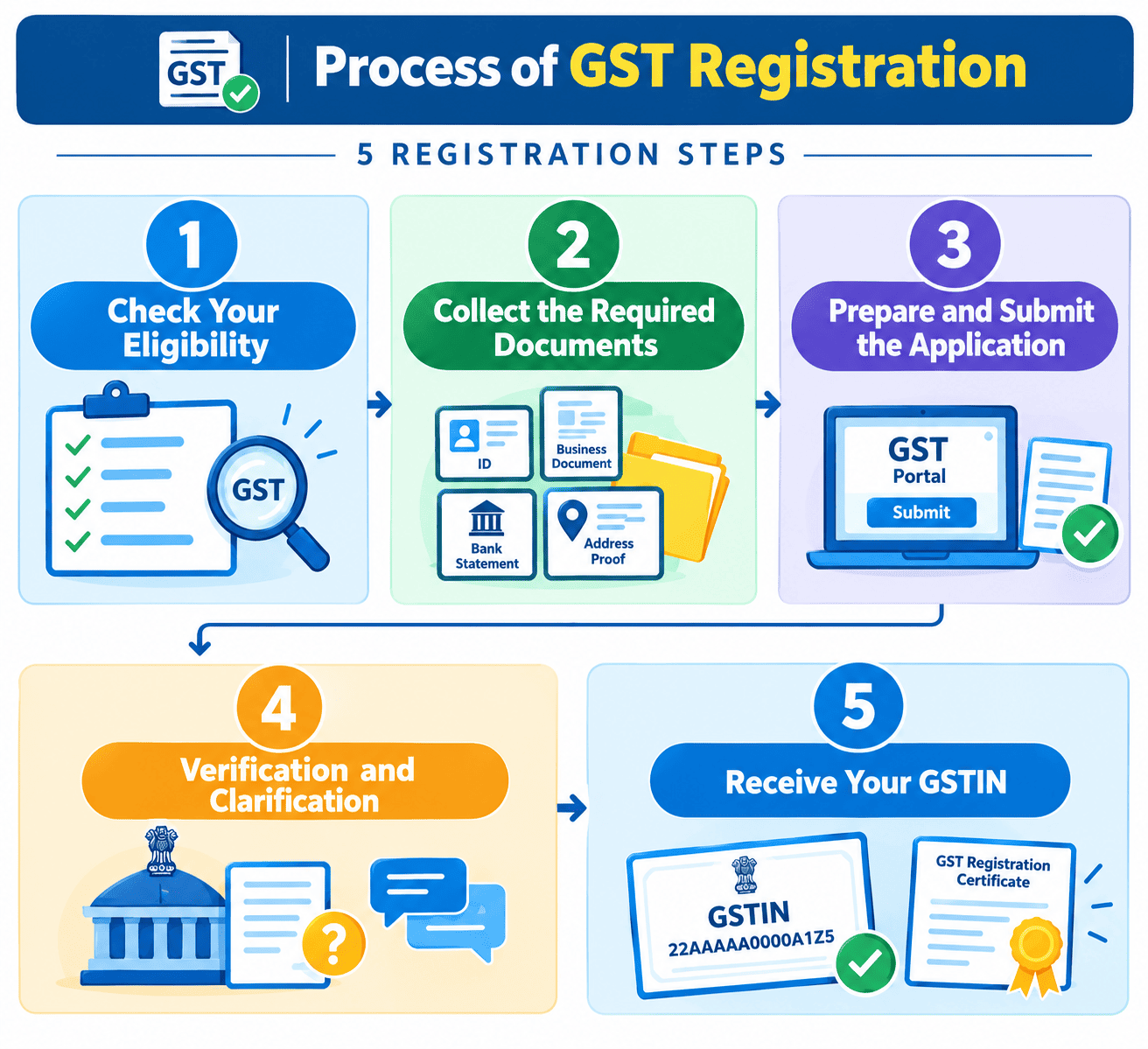
Process of GST Registration
-
Step 1 : Check Your Eligibility We review your business type, turnover, location, and business activities to determine the applicable registration requirements.
-
Step 2 : Collect the Required Documents The necessary identity, business, bank, and address documents are collected for the application.
-
Step 3 : Prepare and Submit the Application The GST registration application is prepared and submitted through the GST portal.
-
Step 4 : Verification and Clarification The GST department reviews the application. If any clarification or additional information is required, it must be provided within the specified time.
-
Step 5 : Receive Your GSTIN Once the application is approved, your business receives a GST Identification Number (GSTIN) and GST registration certificate.
Documents Required for Registration
The documents required may vary depending on the type of business. Commonly required documents include the following.
-
PAN Card Of the applicant or business.
-
Aadhaar Card Of the applicant or authorized signatory.
-
Passport-Size Photograph
-
Proof of Business Address
-
Rent Agreement If the premises are rented.
-
NOC from Property Owner Where applicable.
-
Electricity Bill Or other address proof.
-
Bank Account Details Or a cancelled cheque.
-
Incorporation Certificate For companies or LLPs.
-
Partnership Deed For partnership firms.
-
Authorization Letter Or board resolution for the authorized signatory, where applicable.
Plans & Pricing
Standard
- Everything in Basic plus
- GST Eligibility Consultation
- GST Portal Filing
- ARN Tracking Support
- GST Registration Certificate
- Basic GST Compliance Guidance
*T&C Apply. Government fees and applicable taxes are excluded.
Frequently Asked Questions
Get Personalized Quote for GST Registration
Fill in your details below and our experts will get in touch with you to guide you through GST registration & compliance.