
-
₹3,899/-*
Starting professional fee (excl. Govt fees & taxes) -
2+ Directors
Minimum two directors & members required -
No Profit Distribution
Surplus reinvested into charitable objectives
Section 8 Company Registration in India
Section 8 Company Registration refers to establishing a non-profit organization under Section 8 of the Companies Act, 2013. These entities are created for charitable purposes including promoting commerce, art, science, religion, education, and social welfare. Unlike profit-oriented companies, they reinvest surplus funds into their activities rather than distributing profits to shareholders.
-
Purpose Section 8 Companies focus on charitable or community welfare objectives rather than profit generation.
-
Legal Status Functions as a separate legal entity capable of owning property, entering contracts, and engaging in litigation independently.
-
Name Requirements Does not need to include “Limited” or “Private Limited” at the end, unlike other types of companies.
-
Regulatory Requirements Must obtain licensing from the Registrar of Companies (ROC) under Section 8 of the Companies Act, 2013, demonstrating charitable objectives.
-
Tax Benefits Eligible for tax exemptions and deductions under the Income Tax Act, 1961, if registered under Sections 12A and 80G.
-
Governance Structure A board of directors manages operations; financial surpluses must be directed toward the company’s charitable objectives.
-
Dissolution Upon dissolution, assets must transfer to other Section 8 Companies or similar non-profit entities — they cannot be distributed to members or directors.
Benefits of Section 8 Company Registration
A Section 8 Company combines a formally recognized non-profit structure with tax advantages, strengthening credibility for donors and regulators alike.
-
Tax Exemptions Access to tax benefits and exemptions under the Income Tax Act.
-
Non-Profit Status A legally recognized structure focused on charitable goals.
-
Credibility Enhanced trustworthiness as a registered charitable organization.
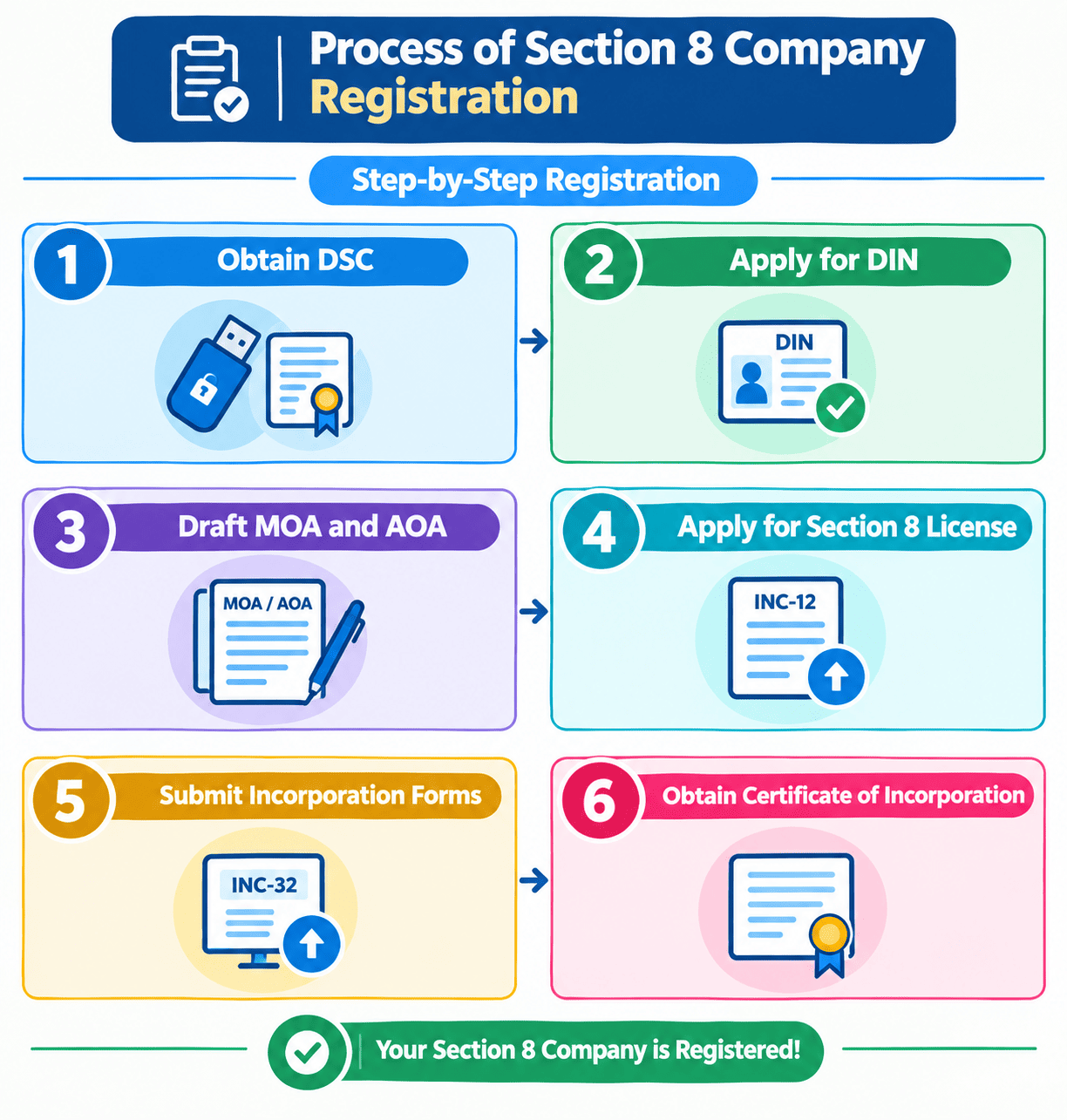
Process of Section 8 Company Registration
Incorporating a Section 8 Company is a fully online process through the Ministry of Corporate Affairs (MCA) portal, and typically follows these steps.
-
Step 1 : Obtain DSC Proposed directors and members require Digital Signature Certificates for electronic form submission.
-
Step 2 : Apply for DIN Director Identification Number is required for all proposed directors through the MCA portal.
-
Step 3 : Draft MOA and AOA Prepare the Memorandum and Articles of Association reflecting the non-profit objectives and internal regulations.
-
Step 4 : Apply for Section 8 License File Form INC-12 with the ROC, attaching the MOA, AOA, and supporting documents.
-
Step 5 : Submit Incorporation Forms After receiving the Section 8 license, file Form INC-32 with the ROC.
-
Step 6 : Obtain Certificate of Incorporation The ROC issues a formal certificate establishing the Section 8 Company.
Documents Required for Section 8 Company Registration
Keep the following documents ready for all directors and members before starting the incorporation process.
-
Identity Proof PAN card, passport, or other government-issued ID.
-
Address Proof Utility bills, rent agreements, or property tax receipts.
-
Digital Signature Certificate (DSC) Required for all proposed directors and members.
-
Director Identification Number (DIN) DIN for all proposed directors.
-
MOA and AOA Memorandum of Association and Articles of Association of the company.
-
Proof of Registered Office Utility bill and NOC from the property owner for the registered office.
Plans & Pricing
Choose the plan that fits your Section 8 Company registration needs — from the core registration scope to a fully-loaded setup with complete MCA incorporation support.
Basic
- Scope of Business
- Instant Filing
- Application Form Preparation
- Documentation Preparation
- DSC Creation
- Name Approval
Standard
- Everything in Basic plus
- Name Reservation Assistance
- MOA & AOA Drafting
- DIN & DSC Processing
- Section 8 License Application
- MCA Incorporation Filing
- PAN & TAN Registration
- Certificate of Incorporation Support
*T&C Apply. Excludes all Govt Fees and Taxes.
Frequently Asked Questions
Get Personalized Quote for Section 8 Company Registration
Fill in your details below and our experts will get in touch with you to guide you through Section 8 Company registration & compliance.