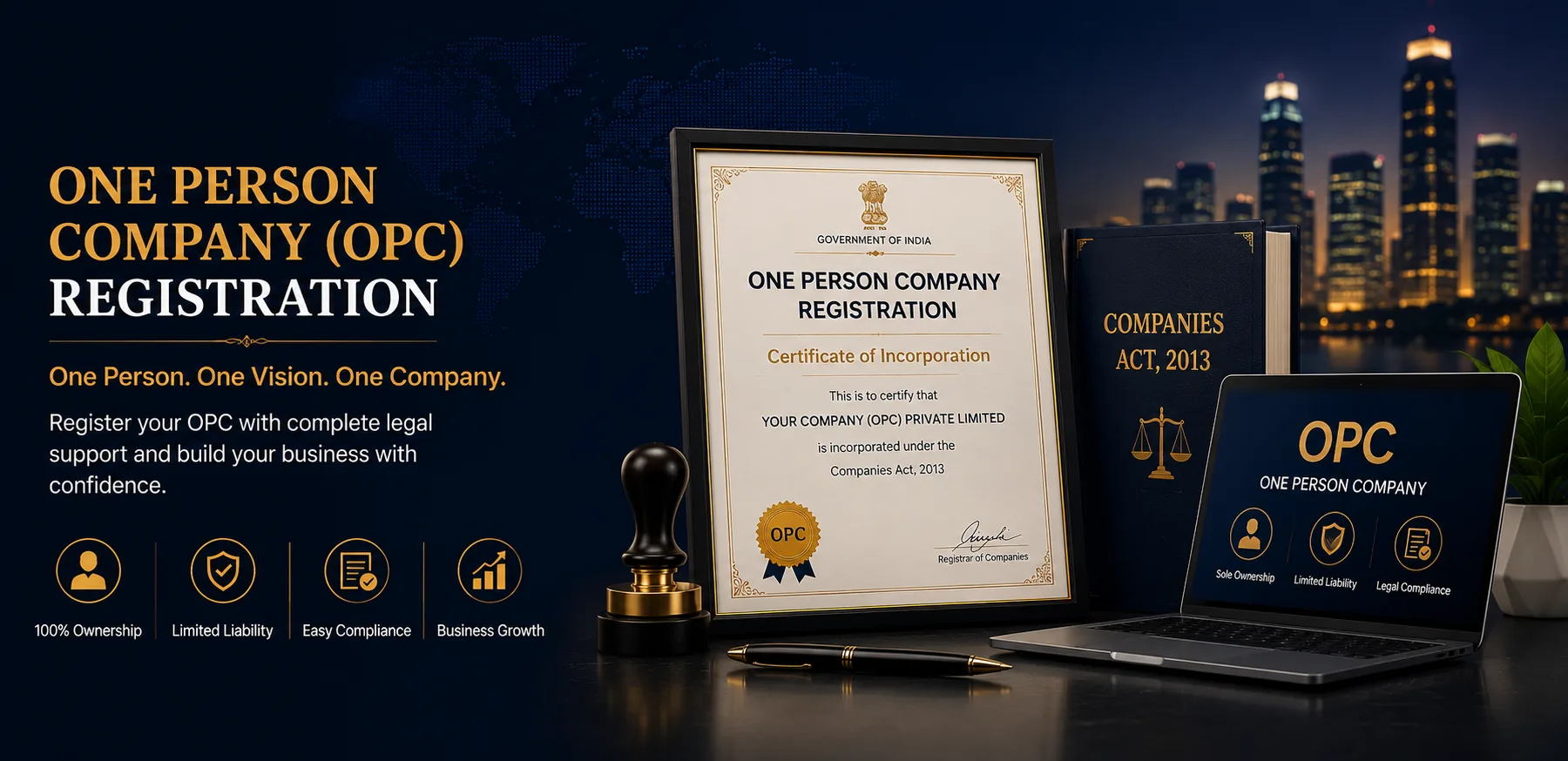
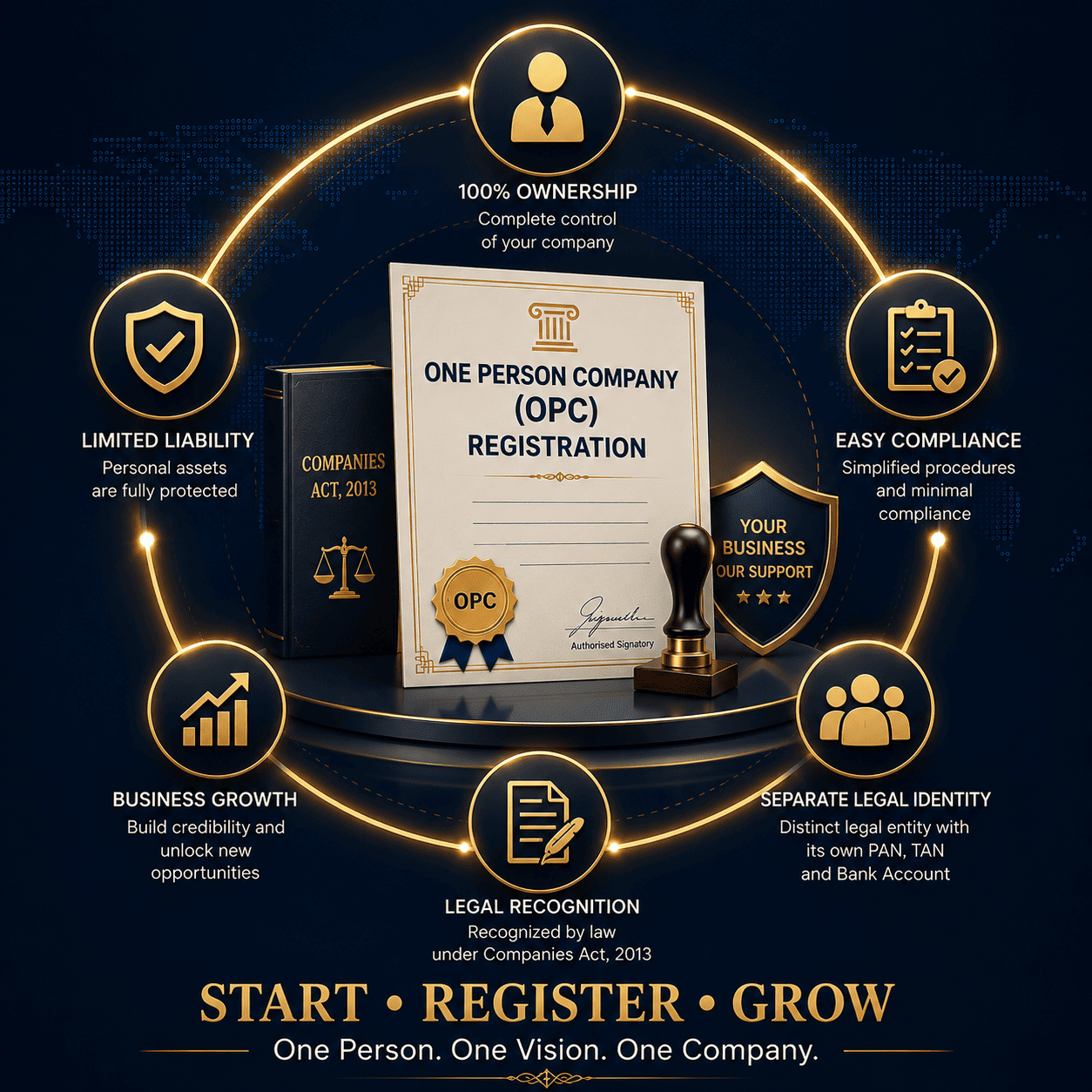
A One-Person Company (OPC) is a unique business structure in India introduced under the Companies Act, 2013. It allows a single individual to own and manage a company, providing the benefits of limited liability while eliminating the need for multiple shareholders. OPC is ideal for solo entrepreneurs who want to operate with a corporate identity and limited liability.
Single OwnerUnlike traditional companies that require at least two shareholders, an OPC allows a single individual to be both the shareholder and director.
Limited LiabilityThe liability of the sole member is limited to the amount they invest in the company, protecting personal assets from business debts.
Separate Legal EntityThe OPC is treated as a separate legal entity from its owner, offering legal protection and tax benefits.
Nominee RequirementOPC registration requires a nominee to be appointed who will take over in case the sole director is incapacitated or passes away.
No Minimum Capital RequirementThere is no minimum paid-up capital requirement for registering an OPC, making it accessible to small businesses and startups.
Benefits of OPC Registration
Registering as an OPC gives a solo entrepreneur the credibility and protection of a company without the need to bring in additional shareholders.
Limited LiabilityThe personal assets of the owner are protected from business liabilities.
Perpetual SuccessionThe OPC continues to exist even if the owner passes away, with the nominee taking over.
Ease of ComplianceOPCs face fewer compliances compared to private limited companies, such as exemption from holding annual general meetings.
Tax BenefitsOPCs enjoy tax deductions and incentives available to private limited companies.
Documents Required for OPC Registration
Before applying for name approval and filing the incorporation form, keep the following documents ready for the director and the nominee.
Identity ProofPAN card of the director.
Address ProofAadhaar card, passport, or voter ID.
Registered Office ProofRent agreement and utility bill of the business address.
Nominee’s ConsentWritten consent from the nominee (Form INC-3).
OPC registration in India is an excellent option for entrepreneurs seeking a corporate structure while enjoying the flexibility and simplicity of sole proprietorship.
Process for Registering an OPC
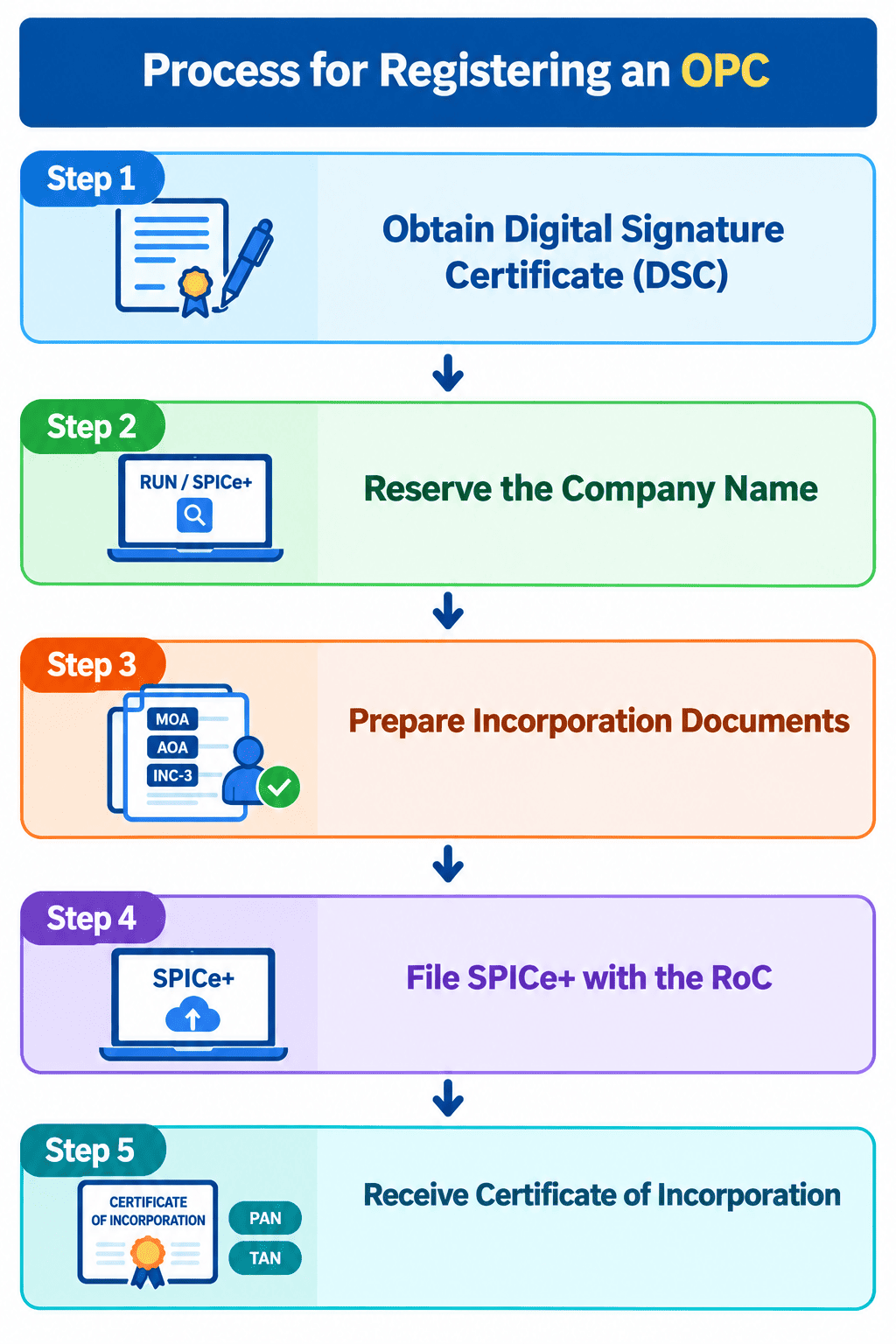
Incorporating an OPC is a fully online process through the Ministry of Corporate Affairs (MCA) portal, and typically follows these steps.
Step 1 : Obtain Digital Signature Certificate (DSC)A DSC is obtained for the proposed director to sign incorporation forms electronically.
Step 2 : Reserve the Company NameThe proposed name is applied for and approved through the RUN / SPICe+ Part A service on the MCA portal.
Step 3 : Prepare Incorporation DocumentsThe MOA, AOA and the nominee’s written consent (Form INC-3) are drafted along with identity and address proofs.
Step 4 : File SPICe+ with the RoCThe SPICe+ (INC-32) form, along with supporting documents and fees, is filed with the Registrar of Companies.
Step 5 : Receive Certificate of IncorporationOn verification, the RoC issues the Certificate of Incorporation along with the company’s PAN and TAN.
Plans & Pricing
Choose the plan that fits your OPC registration needs — from core incorporation to a fully-loaded setup with GST and Udyam registration included.
A One-Person Company is a company structure under the Companies Act, 2013 that allows a single individual to register and run a company as its sole shareholder and director, while enjoying the limited liability, perpetual succession and separate legal identity of a private limited company. Unlike a sole proprietorship, an OPC is a distinct legal entity from its owner, so the owner’s personal assets are shielded from business debts, and unlike other companies it does not need a second shareholder or director to be formed.
Only a natural person who is an Indian citizen and resident in India (having stayed in India for at least 120 days during the immediately preceding financial year) can incorporate an OPC and act as its nominee. A person can be a member of only one OPC at a time, minors cannot be members or nominees, and the proposed director must have a valid PAN, address proof and a registered Head Office in India.
Limited liability that protects personal assets, a distinct legal identity that boosts credibility with banks, vendors and clients, perpetual succession through the nominee, easier access to loans and funding compared to a proprietorship, fewer compliance requirements than a private limited company, and eligibility for the tax benefits and deductions available to companies.
A single shareholder-cum-director structure, limited liability, status as a separate legal entity, mandatory appointment of a nominee, no minimum paid-up capital requirement, and simplified compliance such as exemption from holding an Annual General Meeting.
PAN card and address proof (Aadhaar, passport, voter ID or driving licence) of the director and nominee, the latest utility bill and rent/lease agreement or ownership proof of the registered office, an NOC from the property owner if the premises are rented, passport-size photographs, and the nominee’s written consent in Form INC-3.
A proprietorship has no separate legal identity from its owner, so the owner bears unlimited personal liability for business debts, while an OPC is a distinct legal entity where liability is limited to the owner’s investment in the company. OPCs must be registered with the MCA and follow company-law compliances such as annual filings, and the business continues through the nominee even if the owner dies — a proprietorship typically ends with the proprietor and involves no separate incorporation with the MCA.
Broadly: obtain a Digital Signature Certificate (DSC) for the proposed director, apply for name approval through the RUN / SPICe+ Part A service, prepare the MOA, AOA and the nominee’s consent (Form INC-3), file the SPICe+ (INC-32) incorporation form with the required documents and fees with the Registrar of Companies, and once verified, the RoC issues the Certificate of Incorporation along with the company’s PAN and TAN.
No. There is no minimum paid-up capital requirement to incorporate an OPC — you can start with any capital amount that suits your business, subject only to the authorised capital stated in the incorporation documents.
An OPC can have only one shareholder, but it is permitted to appoint up to 15 directors to help manage the company, as long as the sole shareholder remains the single member. If the shareholder ceases to be a natural person, or the paid-up capital/turnover thresholds for mandatory conversion are crossed, the OPC needs to be converted into a private or public limited company.
The nominee is the person named at incorporation (with their written consent in Form INC-3) who automatically becomes the member of the OPC if the sole director dies or becomes incapacitated, ensuring the company has perpetual succession. The nominee’s name is recorded with the RoC and can be changed by the member at any time by filing the prescribed form.
An OPC is taxed as a private company under the Income Tax Act — at the applicable flat corporate tax rate plus surcharge and cess, regardless of profit level, unlike the slab-based tax treatment available to individuals or proprietorships. It must also comply with provisions such as advance tax, TDS deduction and Minimum Alternate Tax (MAT) where applicable, and is eligible for the standard business deductions available to companies.
Every OPC must maintain proper books of accounts, get its financial statements audited by a chartered accountant, hold at least one Board meeting in each half of the calendar year (with a gap of at least 90 days between them), and file Form AOC-4 (financial statements) and Form MGT-7A (annual return) with the RoC each year, along with its income tax return. OPCs are exempt from holding an Annual General Meeting and from certain other compliances applicable to private limited companies.
Yes. An OPC can voluntarily convert into a private or public limited company any time after two years from the date of incorporation, and conversion becomes mandatory if the paid-up share capital exceeds ₹50 lakh or the average annual turnover exceeds ₹2 crore for the immediately preceding three consecutive financial years, by passing the required resolutions and filing the applicable forms with the RoC.
Yes. An OPC cannot be incorporated to carry out Non-Banking Financial Investment (NBFC) activities, including investing in the securities of other body corporates, and it cannot be converted into a Section 8 (non-profit) company. It is also restricted from voluntarily converting into any other kind of company before completing two years from its date of incorporation, except where the mandatory conversion thresholds are crossed.
The overall cost depends on the authorised capital, professional fees, and government charges such as stamp duty (which varies by state), DSC and RoC filing fees. Our OPC registration plans start at ₹3,899/- in professional fees, excluding government fees and taxes — get in touch for an exact quote based on your requirements.
Get Personalized Quote for OPC Registration
Fill in your details below and our experts will get in touch with you to guide you through One-Person Company registration & compliance.
Call Now — 86919 86919 / 1800 890 2172
Get a Free Quote
Fill in your details below and our team will get back to you shortly.