
Limited Liability Partnership (LLP) Registration

-
₹3,899/-*
Starting professional fee (excl. Govt fees & taxes) -
2+ Partners
No cap on the number of partners -
Limited Liability
Personal assets stay protected
Limited Liability Partnership (LLP) Registration in India
Limited Liability Partnership (LLP) is a business structure in India that combines the features of both a traditional partnership and a company. It was introduced under the Limited Liability Partnership Act, 2008, to provide a flexible and modern approach to business organization while offering the benefits of limited liability to its partners.
-
Limited Liability Partners in an LLP have limited liability, meaning they are only liable for the debts of the LLP up to their agreed contribution. Personal assets are protected from business liabilities, unlike in a traditional partnership.
-
Separate Legal Entity An LLP is a separate legal entity from its partners. This means it can own property, enter into contracts, and engage in legal actions independently of its partners.
-
Flexible Management LLPs offer greater flexibility in terms of management and operations compared to companies. There are fewer statutory requirements and compliance obligations, such as no need for holding annual general meetings.
-
Unlimited Number of Partners An LLP can have an unlimited number of partners, providing flexibility in terms of ownership and participation. This is in contrast to private limited companies, which are restricted to a maximum of 200 shareholders.
-
No Minimum Capital Requirement There is no statutory requirement for a minimum capital contribution to start an LLP, making it accessible for small and medium-sized businesses.
-
Tax Benefits LLPs benefit from tax advantages similar to partnership firms, including no Dividend Distribution Tax (DDT) and the ability to claim deductions and exemptions.
Benefits of LLP Registration
An LLP brings together the operational ease of a partnership with the legal protection of a company, making it a popular choice for professionals and growing businesses.
-
Limited Liability Protects the personal assets of partners from business liabilities.
-
Perpetual Succession The LLP continues to exist even if partners change or leave, providing stability.
-
Lower Compliance Costs LLPs have fewer regulatory requirements and lower compliance costs compared to private limited companies.
-
Operational Flexibility Allows for flexible business management and operations without the need for stringent corporate formalities.
-
Improved Credibility Registered LLPs have a higher credibility in the market, which can be advantageous for securing investments and business contracts.
Documents Required for LLP Registration
Keep the following documents ready for all designated partners before starting the incorporation process.
-
PAN Cards PAN cards of all designated partners.
-
Address Proof Valid address proof of all partners (e.g., Aadhaar card, passport, voter ID).
-
Proof of Registered Office Recent utility bill or property tax receipt, and a rental agreement if applicable. An NOC from the property owner is required if the office is rented.
-
Digital Signature Certificate (DSC) Required for all designated partners.
-
Director Identification Number (DIN) DIN for all partners who will be designated as directors.
-
LLP Agreement Drafted agreement detailing the rights, duties, and responsibilities of partners.
Process of LLP Registration
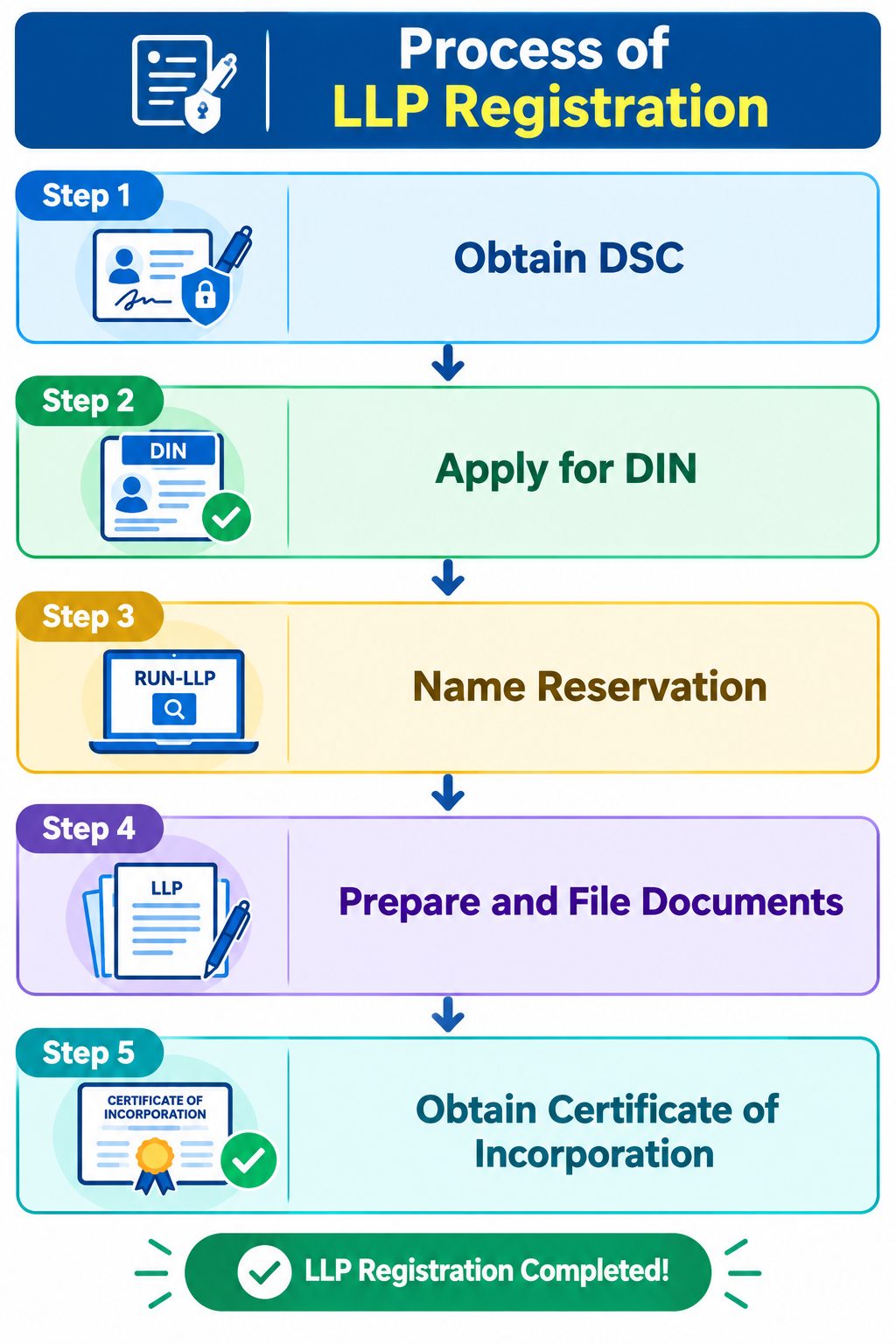
Incorporating an LLP is a fully online process through the Ministry of Corporate Affairs (MCA) portal, and typically follows these steps.
-
Step 1 : Obtain DSC Digital Signature Certificates for all designated partners.
-
Step 2 : Apply for DIN Obtain Director Identification Numbers for all designated partners.
-
Step 3 : Name Reservation Reserve the name of the LLP through the RUN-LLP service on the Ministry of Corporate Affairs (MCA) portal.
-
Step 4 : Prepare and File Documents Prepare and file the incorporation documents, including the LLP Agreement, with the Registrar of Companies (ROC).
-
Step 5 : Obtain Certificate of Incorporation After verification, the ROC issues a Certificate of Incorporation, which signifies the official registration of the LLP.
LLP registration is a popular choice for professionals, small and medium-sized enterprises, and startups looking for a business structure that offers liability protection, operational flexibility, and ease of compliance.
Plans & Pricing
Choose the plan that fits your LLP registration needs — from core incorporation to a fully-loaded setup with GST and Udyam registration included.
Basic
- Scope of Business
- Instant Filing
- Application Form
- Documentation Preparation
- DSC Create
- Name Approval
Advanced
- Everything in Basic plus
- Document Submission
- Form Fill Up
- MCA Document Received
- Udyam
- GST
*T&C Apply. Excludes all Govt Fees and Taxes.
Frequently Asked Questions
Get Personalized Quote for LLP Registration
Fill in your details below and our experts will get in touch with you to guide you through Limited Liability Partnership registration & compliance.