-
BIS Certification
Issued by the Bureau of Indian Standards -
8-Step Process
From application to grant of BIS Licence -
Mandatory & Voluntary
Two certification types available
What is ISI Registration?
ISI Registration, commonly referred to as ISI Mark Certification, is a product certification process under the Bureau of Indian Standards (BIS). It helps manufacturers demonstrate that their products meet the applicable Indian Standards for quality, safety, and performance.
For products covered under mandatory BIS certification requirements, manufacturers must obtain the applicable BIS Licence before manufacturing, selling, or distributing the products in the Indian market. BIS Certification helps manufacturers demonstrate compliance with relevant Indian Standards and strengthens customer confidence in product quality and safety.
Who Needs ISI Registration?
ISI Registration may be required for manufacturers whose products are covered under mandatory BIS certification requirements. It may be relevant for:
-
Indian manufacturers producing products covered by mandatory BIS requirements.
-
Manufacturers supplying applicable products in the Indian market.
-
Foreign manufacturers producing applicable products for the Indian market under the relevant BIS certification scheme.
-
Businesses whose products are specifically notified for compulsory BIS certification.
-
Manufacturers looking to demonstrate compliance with applicable Indian Standards.
The exact ISI Certification requirements depend on the product, applicable Indian Standard, manufacturing process, testing facilities, quality-control arrangements, and relevant BIS regulations.
Types of ISI Certification
-
1. Mandatory ISI Certification Certain products are covered under compulsory BIS Certification requirements. Manufacturers of such products must obtain the applicable BIS Licence before placing the products on the market, as required by applicable regulations.
-
2. Voluntary BIS Certification For products where BIS certification is not mandatory, certification may be available under applicable BIS schemes. Voluntary BIS Certification can help manufacturers demonstrate conformity with relevant Indian Standards and improve customer confidence in product quality and safety.
The availability and requirements of voluntary certification depend on the product and applicable BIS scheme.
Benefits of ISI Registration
-
Demonstrates Product Quality Helps demonstrate conformity with applicable Indian Standards.
-
Builds Customer Trust The ISI Mark can provide customers with greater confidence in product quality and safety.
-
Supports Legal Compliance Helps manufacturers comply with applicable mandatory BIS requirements.
-
Improves Market Acceptance Helps businesses meet applicable certification requirements for the Indian market.
-
Competitive Advantage Helps differentiate compliant products from competitors.
-
Enhances Brand Credibility BIS Certification can strengthen the reputation and credibility of a manufacturer.
-
Supports Business Opportunities Certification may help businesses meet requirements of certain customers, institutions, tenders, and supply channels.
ISI Registration Process
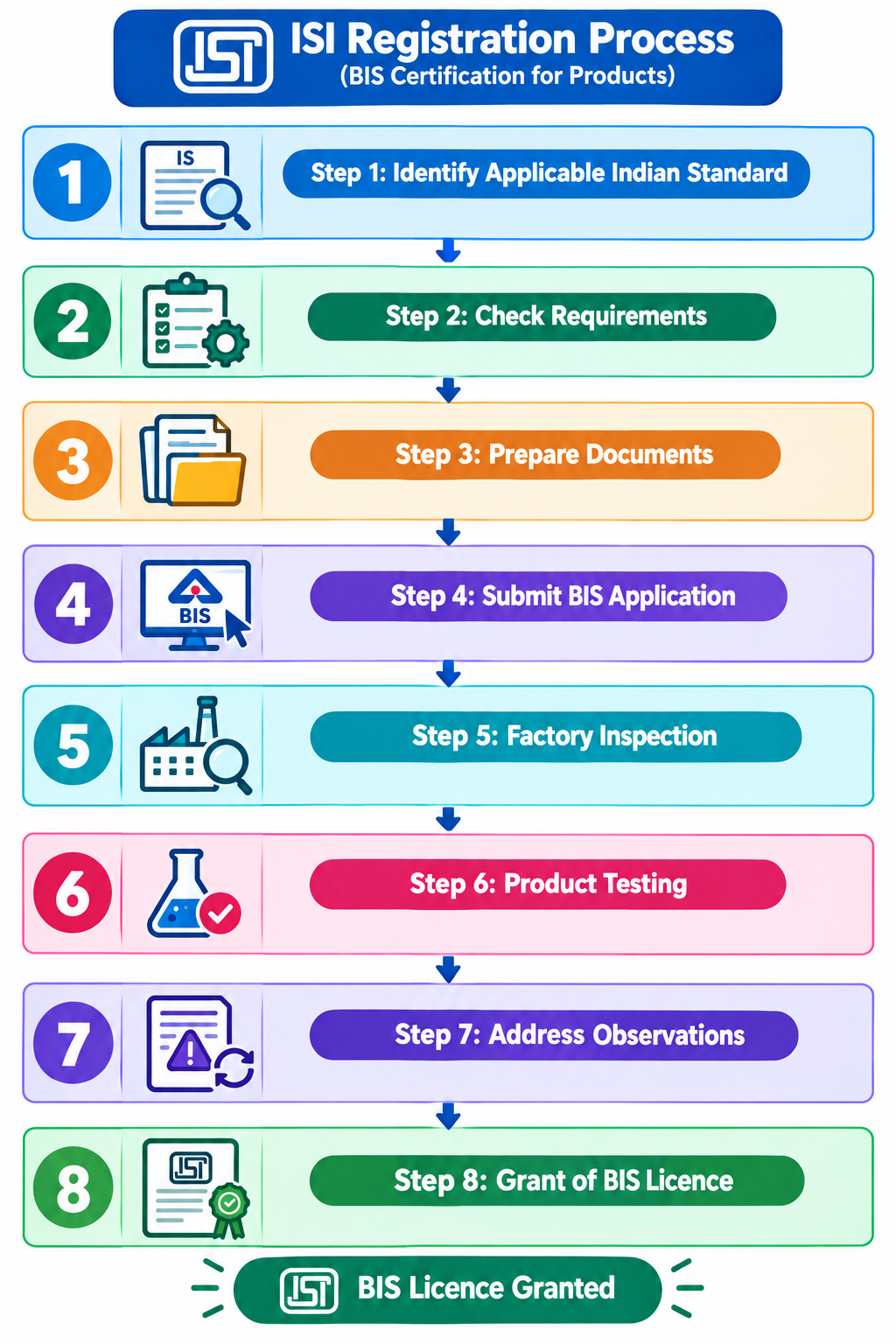
The ISI Registration process varies depending on the product, applicable Indian Standard, BIS scheme, and certification requirements. The general process may include:
-
Step 1: Identify Applicable Indian Standard Determine the Indian Standard (IS) applicable to the product and check whether BIS certification is mandatory.
-
Step 2: Check Requirements Review the applicable product, manufacturing, testing, quality-control, and documentation requirements.
-
Step 3: Prepare Documents Collect the required business, technical, manufacturing, testing, and quality-related documents for the BIS Certification application.
-
Step 4: Submit BIS Application Submit the application and required documents through the applicable BIS certification process.
-
Step 5: Factory Inspection Where applicable, BIS may inspect the manufacturing premises, production process, quality-control system, testing facilities, and other relevant requirements.
-
Step 6: Product Testing The product may be tested through the applicable laboratory or testing process to verify compliance with the relevant Indian Standard.
-
Step 7: Address Observations If deficiencies or observations are identified during inspection or testing, the manufacturer may need to take corrective action and provide the required compliance.
-
Step 8: Grant of BIS Licence After successful evaluation and fulfilment of applicable requirements, BIS may grant the required BIS Licence, allowing the manufacturer to use the ISI Mark according to the licence conditions.
Documents Required for ISI Registration
The exact documents required for ISI Registration in India vary depending on the product and applicable BIS scheme. Common documents may include:
-
Business registration documents
-
Factory address proof
-
Manufacturer details
-
Product specifications and technical information
-
Manufacturing process details
-
Details of machinery and equipment
-
Testing facility details
-
Quality-control procedures
-
Product test reports, where applicable
-
Raw material and component details
-
Authorized signatory documents
-
Other product-specific documents required by BIS
Preferred Client Combos
-
MSME & ISO Combo
-

Trademark & Copyright Combo
-

FSSAI & IEC Combo
Plans & Pricing
Basic
- Scope of Business
- Eligibility Check
- Form A
- Documentation Preparation
Advanced
- Everything in Basic plus
- Application Submission
- Application Review
- Documentation Resubmission
- Approval – Registration Certificate
Get a custom quote for this service — contact us and we'll walk you through the fees and process.
Frequently Asked Questions
Get Personalized Quote for ISI Registration
Fill in your details below and our experts will get in touch with you to guide you through ISI Registration.