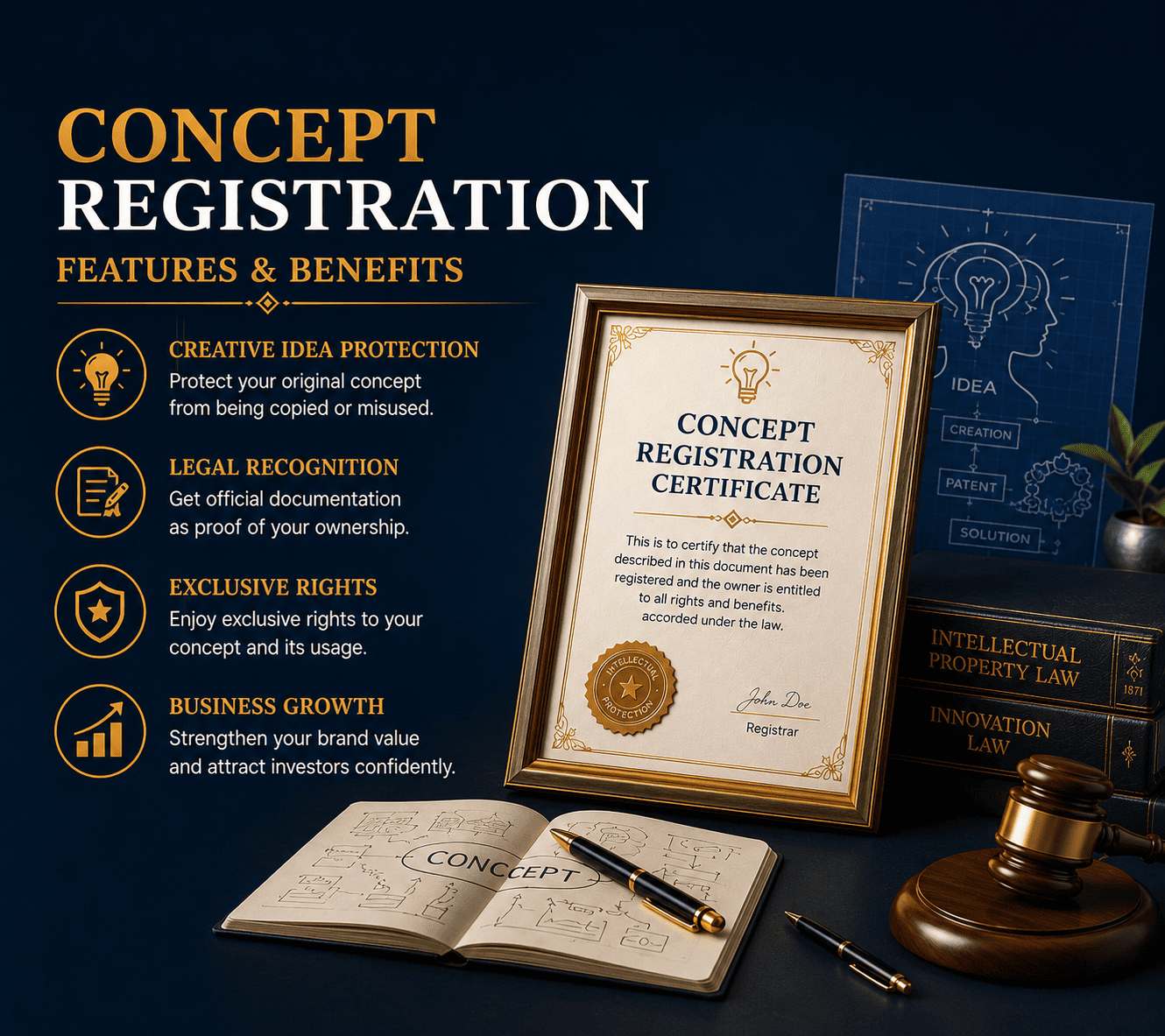
-
60 Years
Concept copyright validity -
Original & Applicable
Must be new with practical use -
Legal Protection
Secures exclusive rights to your concept
What is Concept Registration?
Got a brand-new idea in your head, maybe a product, a service, or a business? Good ideas don't stay secret for long. Concept registration is how you claim it as yours, before someone else does.
In simple words, it's a legal way to protect your idea. Just having an idea isn't enough, you need proof. Concept registration gives you that proof: an official record that shows the idea was yours, and when you had it.
To qualify, your concept needs to meet two conditions:
-
It must be original It has to be new and not already publicly shared before you register it.
-
It must be applicable It should have genuine potential for practical use or commercial value, not just a vague, abstract thought.
BDS Legal helps innovators, founders, and businesses across India with pan-India support to get their concepts properly documented and protected before they go any further.
What Does Concept Registration Actually Protect?
It’s important to set realistic expectations here. Concept registration generally protects the specific details and expression of your idea — how you’ve described and documented it — rather than the broad idea itself in the abstract. Once registered, though, you gain the right to enforce your intellectual property and take action against anyone using or copying it without your permission.
Duration & Renewal
How long your protection lasts depends on which type of intellectual property your concept falls under — patents, trademarks, and copyrights each carry different terms. As a benchmark, concept copyright validity typically runs for 60 years. Some forms of protection may also require periodic renewal to stay valid, so it’s worth understanding which category your concept falls into early on.
Benefits of Concept Registration
-
Legal Protection You get exclusive rights to your concept, stopping others from using, copying, or exploiting it without your permission.
-
Commercial Advantage A documented, protected concept is far more attractive to investors, partners, and buyers than an idea with no paper trail behind it.
-
Stronger Market Position Having a legally recognized claim to your concept strengthens your standing if a dispute or competing claim ever comes up.
-
Peace of Mind You can discuss, pitch, or develop your idea further without constantly worrying about someone else taking credit for it.
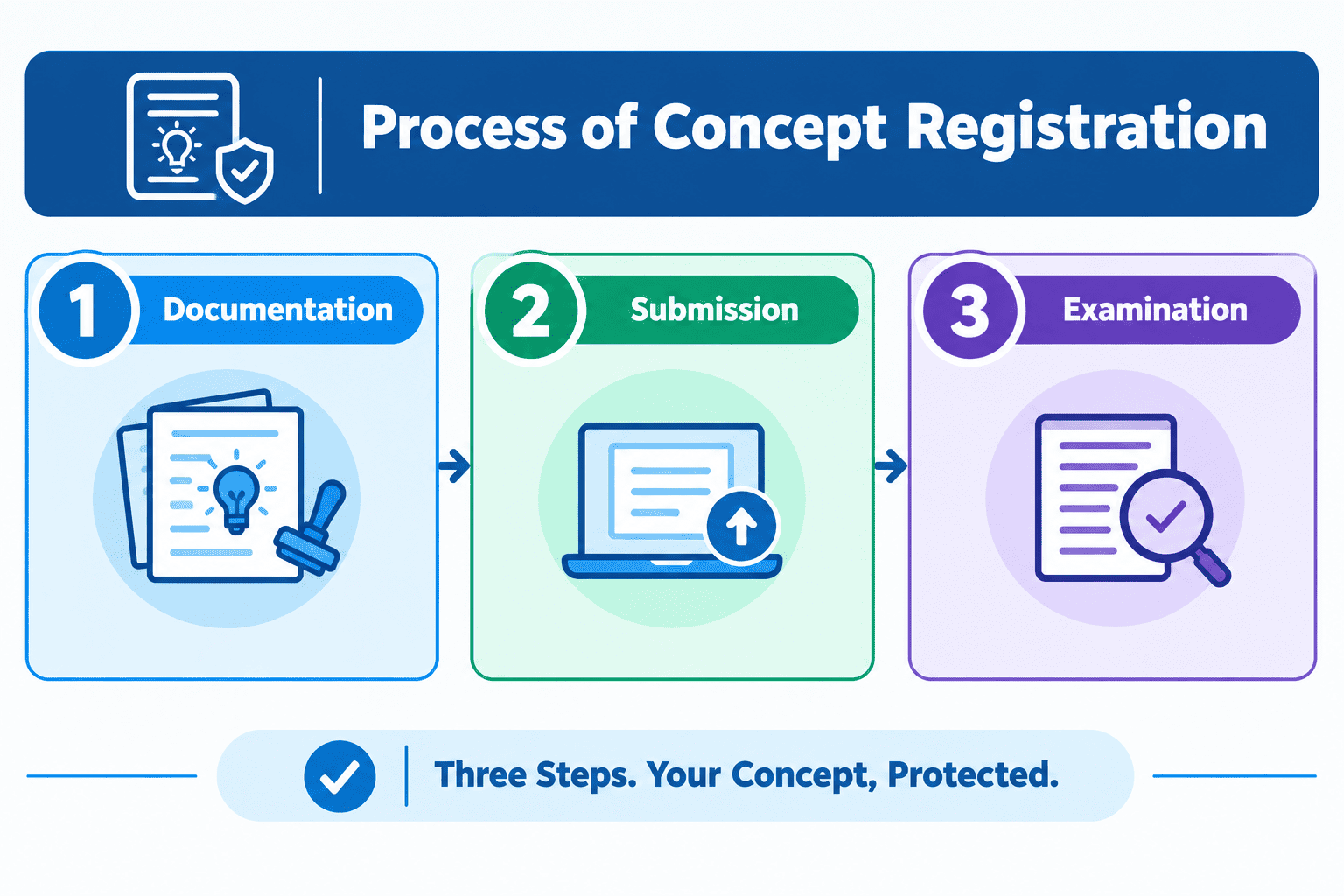
Process of Concept Registration
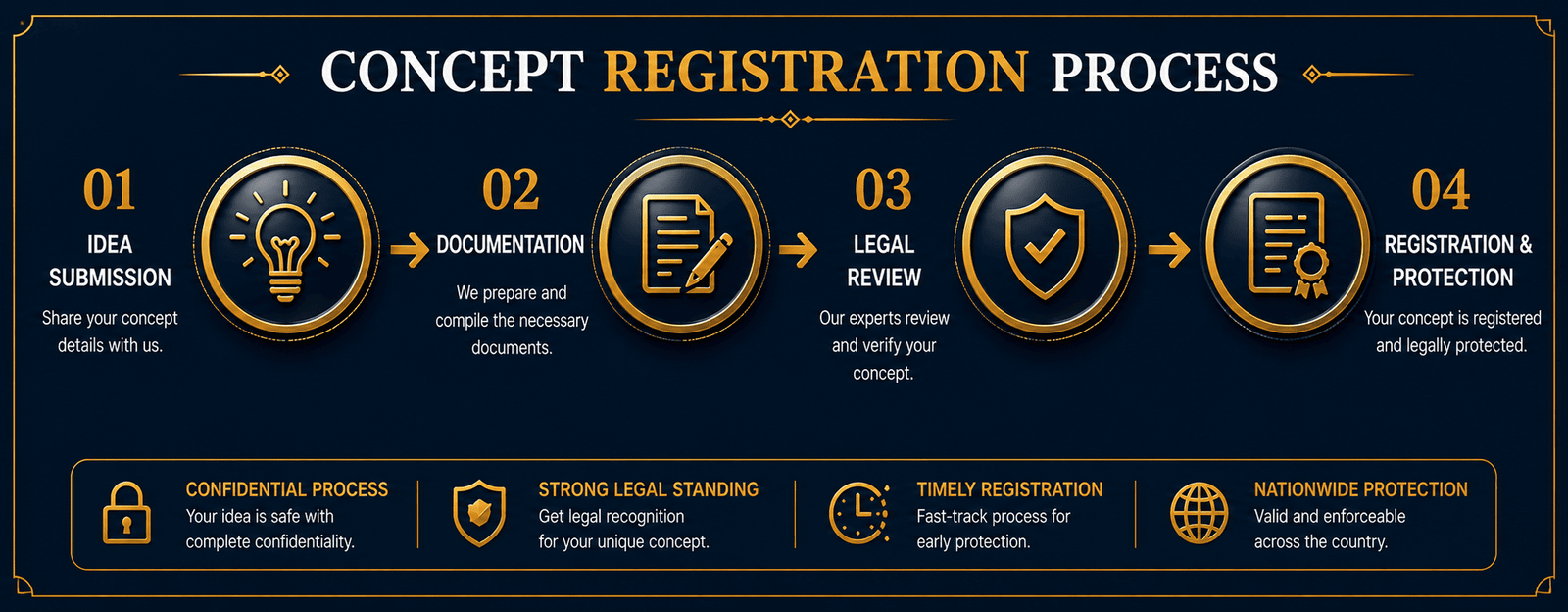
Filing for concept registration comes down to three main steps.
-
1. Documentation Prepare a detailed written description of your concept, including its features and what makes it genuinely innovative. This typically needs to be submitted as three signed and stamped sets of the concept documentation.
-
2. Submission File your application with the relevant intellectual property office — this could be the patent office, trademark registry, or copyright office, depending on the exact nature of your concept.
-
3. Examination The application is reviewed to check whether it meets the criteria required for the type of protection you're seeking.
Documents You'll Need
-
A detailed concept description, covering its features and what's genuinely innovative about it
-
Proof of originality, showing the concept hasn't been publicly disclosed before
-
A completed application form for the relevant type of IP protection (patent, trademark, or copyright)
-
Identification documents applicant ID or business registration certificate
-
Payment of the applicable registration fee
-
Power of attorney or legal authorization, if a representative is filing on your behalf
Plans & Pricing
Getting started is simple and affordable. BDS Legal’s Basic Plan starts at ₹599 onwards* and covers everything you need to check your concept qualifies.
Basic
- Scope-of-Work Assessment
- Correct Classification
- Preliminary Search
- Professional Search Services
Standard
- Everything in Basic plus
- Full Application Drafting
- Classification Under the Right Category
- Filing With the Copyright Office (Online or Offline)
Advanced
- Everything in Advanced plus
- Handling the Examination Stage
- Responding to Examination Report & Hearings
- Submitting Supporting Evidence
- Follow-Through to Final Registration
We help clients secure Concept Copyright across India with transparent pricing and
end-to-end support — contact us for a quote, and we'll clearly explain the fees,
process, and services included before you proceed.
Frequently Asked Questions
Get Personalized Quote for Concept Registration
Fill in your details below and our experts will get in touch with you to guide you through Concept Registration.